Week 38 represents an exceptionally rigorous and methodologically significant milestone for the global digital forensics and incident response discipline. From the telemetry of hybrid cyber warfare in Eastern Europe and critical infrastructure defense to sophisticated open-source supply-chain poisoning in the Rust ecosystem and breakthroughs in temporal graph provenance learning, the past seven days have demanded uncompromising forensic rigor. As threat actors integrate adaptive machine learning techniques and stealthy evasion protocols, deterministic analysis and an uncompromised chain of custody remain the bedrock of digital evidence integrity.
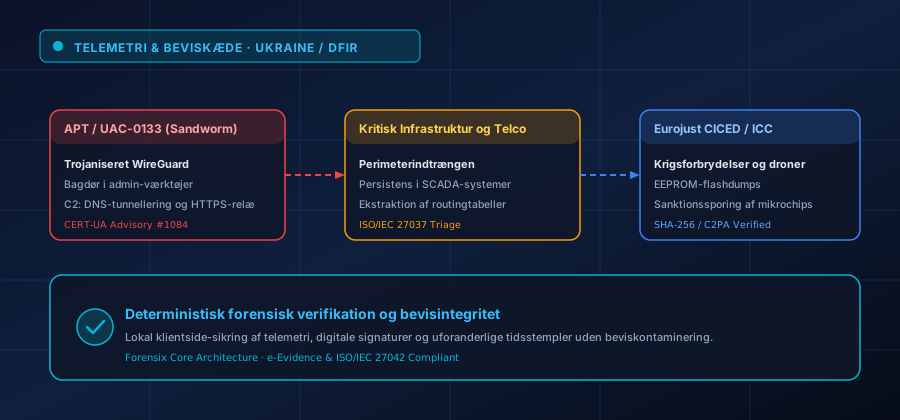
In the theater of geopolitical cyber warfare, digital evidence acquisition across Ukraine's critical infrastructure has established critical benchmarks. Recent telemetry published by CERT-UA and allied incident response units reveals that advanced state-sponsored clusters, notably Sandworm (UAC-0133), have escalated targeted deployments of trojanized administrative toolchains and modified VPN clients built upon the WireGuard protocol to secure persistent deep footholds in industrial control and telecommunication backbones. Concurrently, international evidentiary coordination through Eurojust's Core International Crimes Evidence Database (CICED) continues to standardize forensic metadata schemas and cryptographic timestamp verification on downed unmanned aerial systems (UAS), where hardware forensic practitioners extract serial EEPROM dumps to trace sanctioned dual-use microcontrollers.
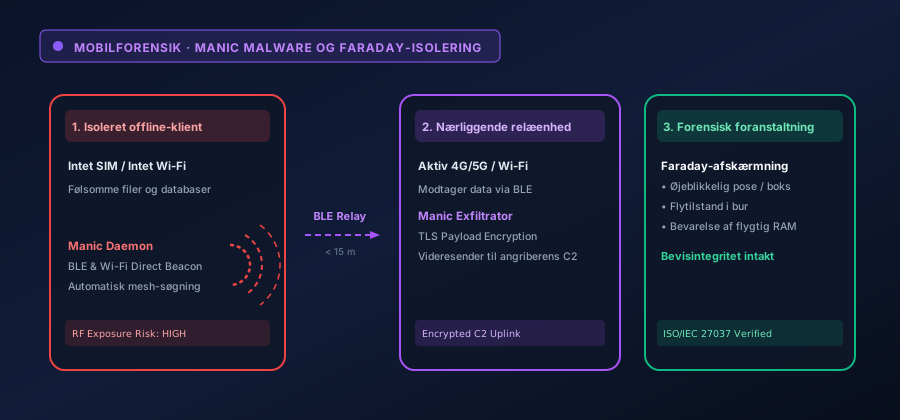
Within mobile forensics and endpoint security, the discovery of Forensix Daily Briefing: 2026-09-14 — Situation Overview & Technical Analysis has drawn significant attention. This Android-based malware demonstrates an evasive relay exfiltration technique capable of siphoning data from air-gapped endpoints through proximate compromised devices over Bluetooth Low Energy (BLE) and Wi-Fi Direct. For triage teams securing physical scenes, this reinforces the absolute necessity of immediate Faraday shielding and verified RF isolation before volatile memory state and local ad-hoc connections become degraded.
On the vulnerability landscape, response teams worldwide have mobilized around remediation windows tracked in CISA's Known Exploited Vulnerabilities Catalog, highlighted by critical remote code execution vectors in Microsoft SharePoint (CVE-2026-63520) and zero-day vulnerabilities in Cisco ASA/FTD, requiring immediate patch verification and defensive forensic log hunting across exposed perimeter appliances.
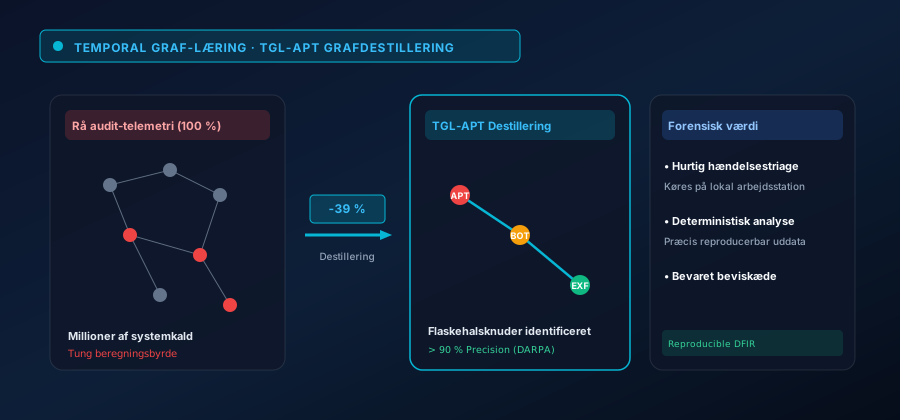
Among the premier academic breakthroughs of the week is Urgent Alert: Maximum-Severity Cisco ISE Zero-Day (CVE-2026-76460) Under Active Exploitation, introducing the TGL-APT framework. The research authors tackle the persistent telemetry bottleneck in enterprise provenance graphs by applying temporal graph learning and distillation. By compressing massive system audit logs, computational processing demands are slashed by up to 39 percent while sustaining over 90 percent detection precision on DARPA benchmark sets, enabling deterministic reconstruction of advanced multi-stage intrusions without prohibitive compute infrastructure.
In parallel, Forensix Daily Briefing: 2026-09-15 — Situation Overview & Technical Analysis reveals how genetic algorithms can optimize low-entropy ransomware execution to mirror standard operating system file I/O, evading legacy EDR heuristics. Defensively, the release of COPA (Continual Preference Optimization) proves that client-side defense models can counteract adaptive prompt injections in real time without sending sensitive investigative data to external cloud APIs, strictly adhering to EU AI Act Articles 14 and 50.
Looking toward the upcoming week, key operational dates include Wednesday August 26, when the European Commission technical advisory group publishes the cross-border preservation standards under the e-Evidence Regulation. Additionally, CISA's binding remediation deadline for CVE-2026-63520 concludes on Friday August 28, requiring verified containment of exposed appliances. Forensic response teams are also calibrating telemetry ahead of the SANS DFIR Summit on September 1.
Special technical recognition is extended this week to the research authors of Urgent Alert: Maximum-Severity Cisco ISE Zero-Day (CVE-2026-76460) Under Active Exploitation, the incident response analysts at CERT-UA, and the open-source maintainers of LibFuzzer and YARA for releasing open, reproducible datasets, decompiled artifacts, and validated detection rules that advance digital evidence integrity across the forensic discipline.
En tryg weekend ønskes I alle Forensix Redaktionsgruppe