Angreppsteknik
Logganalys för AI-ramverksintrång
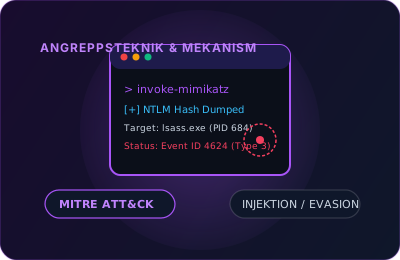
Systematisk granskning av loggfiler för att identifiera obehörig åtkomst, manipulering eller exfiltrering inom AI-ramverk som MLflow, TensorFlow Serving eller Kubeflow.
🔬 Forensisk Betydelse & Utredningsmetodik
Kritisk för att spåra angripares rörelser inom AI-infrastrukturen, identifiera dataläckage eller modellmanipulation, och rekonstruera attackkedjan i incidenter som involverar AI-ramverk.
🛠️ Praktiska Triage- & Analyskommandon (Cheat Sheet)
⚡ Extract MLflow Server Logs (Linux)
sudo find /var/log/mlflow/ -type f -name "*.log" -exec cp {} /forensics/evidence/mlflow_logs/ \; && sudo chown -R forensics:forensics /forensics/evidence/mlflow_logs/
Collects all MLflow server logs for offline analysis to detect unauthorized model registrations or API calls.
⚡ Kommando
tshark -r /var/log/tensorflow/serving/tf_serving.pcap -Y "http.request or http.response" -w /forensics/evidence/tf_serving_filtered.pcap
Filters TensorFlow Serving network traffic for HTTP requests/responses to identify anomalous prediction queries or model updates.
⚡ Kubeflow Pipeline Log Extraction (Kubernetes)
kubectl logs -n kubeflow --since=24h --tail=1000 > /forensics/evidence/kubeflow_pipeline_logs.txt
Extracts recent Kubeflow pipeline logs to identify unauthorized pipeline executions or data exfiltration attempts.
⚡ YARA Scan for Malicious MLflow Artifacts
yara -r /forensics/rules/mlflow_malicious.yar /var/lib/mlflow/artifacts/
Scans MLflow artifact storage for known malicious patterns (e.g., poisoned models or backdoored datasets).
⚡ Volatility Memory Analysis for AI Process Tampering
volatility -f /forensics/memory_dump.raw --profile=Win10x64_19041 linux_pslist | grep -E "mlflow|tensorflow|kubeflow"
Identifies running AI framework processes in memory to detect injection or tampering (Linux/Windows).
⚙️ Tekniska Parametrar & Verktygsstöd
- Filsystemsplacering (på undersökt media):
['/var/log/mlflow/', '/var/log/tensorflow/serving/', '/var/log/kubeflow/', '~/.mlflow/', 'C:\\Program Files\\MLflow\\logs\\', 'Registry: HKLM\\SOFTWARE\\MLflow\\'] - Forensiska verktyg: Splunk ELK Stack (Elasticsearch, Logstash, Kibana) Grafana Loki Sigma Rules YARA Volatility (for memory forensics) ↗ FTK Imager ↗ Autopsy ↗ Zeek (Bro) ↗ tshark
- MITRE ATT&CK:
['T1070.001 (Indicator Removal: Clear Windows Event Logs)', 'T1562.001 (Impair Defenses: Disable or Modify Tools)', 'T1059 (Command and Scripting Interpreter)', 'T1021.004 (Remote Services: SSH)'] ↗ - Relevanta Event ID:n:
MLflow: 1001 (Model Registry Event),TensorFlow Serving: 2001 (Prediction Request),Kubeflow: 3001 (Pipeline Execution) - Standarder:
NIST SP 800-92 (Guide to Computer Security Log Management),ISO/IEC 27037:2012 (Guidelines for identification, collection, acquisition and preservation of digital evidence),MITRE ATT&CK for Enterprise (TA0001, TA0005)
📊 AI Framework Breach Detection Workflow
[AI Framework Logs] --> |Parse| [Log Aggregator (ELK/Splunk)]
[Log Aggregator] --> |Filter| [Anomaly Detection (Sigma/YARA)]
[Anomaly Detection] --> |Correlate| [MITRE ATT&CK Mapping]
[MITRE ATT&CK Mapping] --> |Triage| [Incident Response]
🔍 Förekomst i Forensix Intelligence & Fallstudier
📚 Källor & Fördjupning
🏛️ NIST
NIST SP 800-92: Guide to Computer Security Log Management
Läs specifikation →
🏛️ MITRE
MITRE ATT&CK: Adversarial Tactics, Techniques, and Common Knowledge
Läs specifikation →
🏛️ CISA
CISA Alert: Critical Vulnerability in MLflow (AA23-144A)
Läs specifikation →
🏛️ SANS
SANS DFIR: Detecting AI Framework Abuse
Läs specifikation →